Saturday, 21 May 2016

Myth Busters

Eskimos in Alaska don't build igloos. They build sod covered houses in the ground, and on the Alusian Islands, they are completely buried, because of the wind. Polar bears only live in the extreme north. Huskies don't look like Australian huskies either.
Note that this is the tourist entrance. The real entrance is much smaller. They are made to hide from bears.

I saw some Eskimo dances today, as well as huts representative of each group of peoples in Alaska, their boats and handcrafts.

Ran into a bunch of Australians at the Captain Cook statue overlooking the bay from Anchorage. It looked nothing like him.

Tomorrow Denali.

Where it is wet

Whittier has 97 inches of rain every year, and 36 or so feet of snow (the record is 46 feet), and is the wettest place in the US. 90% of the population live in one building (originally the officers quarters), but the school is over the road. There is a tunnel from the housing complex to the school. The other big building is the barracks, but it hasn't been used since the 1964 earthquake. There is an enormous Kittiwake rookery opposite.

To get there you need to drive through a dual use railway/automobile one way tunnel which is two and a half miles long.

I went on a 26 glacier tour of prince William Sound. This is college fjord, where all the glaciers are named after US colleges. 

We saw a humpback whale in Esther Passage.

And sea otters with their babies on top.

Surprise glacier had sea lions, seals and more sea otters.


There was a cave with a waterfall at Baker glacier.

And goats in the hills


Thursday, 19 May 2016

More Totem Poles

I wandered around downtown Anchorage, and visited the three totem poles - Raven and eagle on one street corner, and Tlingit bear on another.

Just near the first one is the native knitters cooperative, which sells musk ox wool things. Musk ox is the warmest wool in the world, and doesn't shrink as it has no barbs and won't felt. It is frightfully expensive, as it is difficult to harvest, each musk ox only gives about 4 to 6 pounds of wool a year (it's a down undercoat, similar to cashmere), and there aren't many around. The women from different isolated communities harvest the wool, it is accumulated for several years until they have enough (600 pounds) to get spun commercially, and then they knit it. They had a wonderful display of samples of various animal wools knitted up - many of them I hadn't seen before - Buffalo, the three South American fur animals, bison as well as all the standard animals.

I also saw the first permanent building in Anchorage, which is also the oldest (I can't understand why it wouldn't be).

And then I saw a lynx hat in a fur shop window - there are more here than I have ever seen before. They also had a similar fox hat.

Wednesday, 18 May 2016

Farewell RV

I was sorry to return the RV today - it was a marvellous way to see the country, and gave me a lot of flexibility. I may not have been able to do what I did without it. It meant I didn't need to unpack and pack every time I moved. The facilities allowed me to camp by the side of the road if worst came to worst. It was a beautiful machine, having done only 4000 miles. I put on over 5000.

On the other hand, the microwave was very high, and I needed to stand on one of the chairs to see into it. As the turntable often came unstuck while driving, I often needed to stand on the chair. Also, getting things down out of it was difficult. Similarly, the high cupboards were just a bit too high for me. I didn't use the shower or the burners for cooking because of the logistics involved, as using the shower would have meant the whole bathroom needed to be dried out, while the weather was generally too cold to use the burners as you were supposed to have windows open. And every city and set of roadworks were a bit of a challenge as it was a bit too wide, and you can't set a GPS to only go on wide roads.

Today I saw the museum of Alaska, as as it was Museum day, it was FREE! It has a very good exhibit of the Native peoples of Alaska, with maps and items from each group. The first photo was taken very early, of a traditional house. Then there are woven and button garments, and the last photo is of some of the very fine sea grass basket weaving I commented on previously.

There was also an exhibit about polar bear dens. Evidently this is a reconstruction of one of them

Anchorage is broad. There is very little multi-storey development, there are lots of parks, and at least one freeway.

Near where I am staying (in the city centre) is a gravel and dirt block of land which currently has van/pop-up eateries, some portaloos and a giant tent with picnic tables and chairs. By June they expect to have up to 30 vendors. Here is the most amazing vendor.

As requested, I actually bought one of their concoctions. They put the banana in a vice to straighten it, cut the bottom, core the banana, and then slide one or two fillings into the hole. Peanut butter is popular. Many of the fillings are a similar colour to the banana, so for maximum effect, I chose Nutella and M&Ms. The vendor says they are very good as you peel them as you eat them, so there is no mess! Note: this was not my idea.

Back to Anchorage

Today I went up the coast to Kenai and back to Anchorage. I hoped to get a better view of the active volcano, but even though the road hugs the coast, the trees are dense and there is a lot of development. 

I ended up going to Captain Cook State recreation area (one place he landed) which was the end of the road, and there was a family with boogie boards on what passes for a beach around here.

Kenai was well worth seeing. It had a Russian Orthodox Church and chapel, and a number of historic buildings dating from Russian times and from early American settlement. The local visitors centre had a museum attached. Although the museum was very small - basically one room - it had an amazing collection including explanations of the three different groups of indigenous peoples, many well selected artifacts, including an incredibly intricate sea grass basket and model seal skin kayaks and dolls from each of the groups in their traditional costume, a model oil rig, and a first edition print of Cook's voyage.

The road back to Anchorage was still full of roadworks, so I didn't stop much. The shot of the bay was taken while I was waiting for 20 minutes at one set of roadworks.

Homer

It was a wet day, so I didn't do any adventuring. Homer has a number of buildings on the spit, which in some places is only really wide enough for the road which goes to the end, where the boat harbour is located. There are a lot of shops there, and a number of residences.

The rest of Homer is on the hills surrounding the spit. The Pratt museum is very community based, with lots of paintings and quilts mixed in. For instance there was a bear exhibit, with the studies that had been done on brown/grizzly bear numbers and habits, stuffed bear, skeleton and paintings sculptures and quilts of bears. It was very well done. They also integrated the indigenous community into the exhibits very well.

Monday, 16 May 2016

Volcano

This morning I went to the Alaska Sea Life Center. It has aquariums with fish and other sea creatures from around Alaska, as well as games (see who can catch the most fish...) film and explanations. The two exhibits I liked the most were the sea birds (which was two floors high, at the bottom you could see the birds swimming underwater with the fish, and up top they were swimming on the surface) and the jellyfish.

Then I went to Hammer. There was a never ending stream of cars in the other direction.

 I stopped at the Russian Mission on the way.

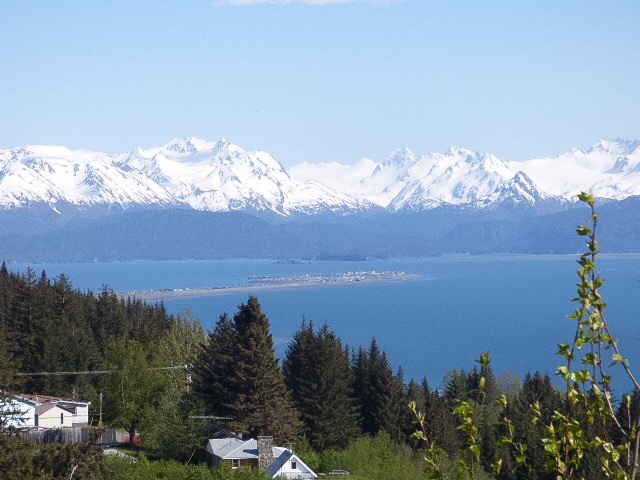
I didn't actually get to Hamer - it is on the spit you can see here.

You could see for miles across the Cook inlet (named after Captain Cook), to the glaciers more than 60 miles away.

I could even see this volcano (it's the best picture I could get because it's so far away).

And my campground tonight and tomorrow...