Wednesday, 7 February 2024

Pulu Blan Madar

This morning I decided to try to photograph sunrise over the lagoon. It would have helped if I’d realised that West Island is hook shaped, and since I went to the hooked end, I was going to face west rather than east. But after some confusion, I found the sun.


There were a lot of crabs around, both ghost crabs 

and the land crab you see here.


Then I went on a motorised canoe tour around the islands in the south of the atoll, including the one that’s just been named the fifth best beach in Australia, Pulu Balan Madar.


It has an enormous number of hermit crabs, which don’t like the sun.


Pulu Balan where there are a population of Christmas Island skinks. These were being decimated on Christmas Island, and some were taken to toronga zoo and bred in a captive breeding program. Then they were located here. They’re now extinct on Christmas Island.


After we came back, I went over to Home Island for the special Cocos Malay banquet that’s held on Wednesday nights. The food was absolutely delicious, and an interesting blend of Malay and English food.

Tuesday, 6 February 2024

Turtles

Early today I visited the Big Barge. This was a boat built in 1970 under the auspices of John Clunies-Ross, and used to go to North Keeling island and beyond. Unfortunately, it sank in the 1990s. It was recovered some time recently, and the Shire and Commonwealth government put in funds to enable it to be restored. It’s now an art gallery and cafe. 


The lagoon at Cocos (Keeling) Islands is estimated to have over 30,000 turtles living in it. About half of them are critically endangered hawksbill turtles (their shells used to be made into tortoiseshell items, and they were nearly hunted to extinction), and half are green turtles. When turtles nest, they go back to where they were born, and most of these turtles don’t nest here. But when they have tracked the turtles in this lagoon, a surprising number live here most of the time.

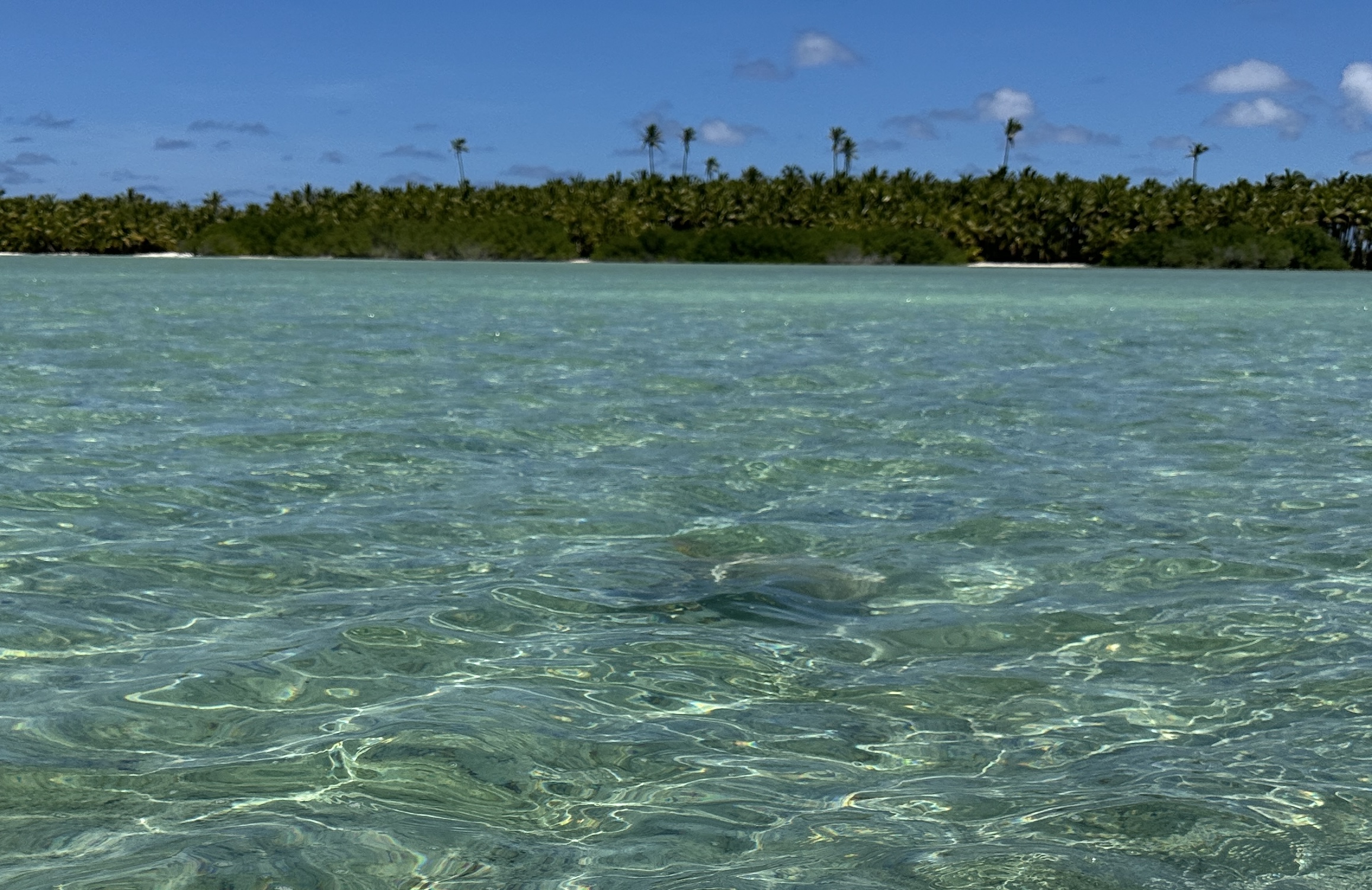
Today I went on a turtle tour, where we puttered around in a part of the lagoon very close to West Island spotting turtles and other marine life. I guess we saw about 100 hawksbill turtles and about 15 green turtles. Hawksbill turtles are extremely fast. As soon as they put their heads up and see a canoe anywhere nearby they stop resembling a rock, and change into rocket mode and disappear very quickly. So I had a hard time getting any pictures. However, this was the best I did.
 
We were in about a maximum of half a metre of water, so it was quite shallow, and you could see the sea grass and sponges they were feeding on. 


Turtles weren’t the only thing we saw. Both mullet and bone fish leap in the air repeatedly. At one stage a group of about twenty mullet came straight for us, and we were both sure they’d end up leaping into the boat - but they didn’t. One of the attractions of Cocos (Keeling) Islands is that there are bone fish here - they’re evidently very difficult to catch and people come here from all over the world to try (you don’t eat them as they’re full of bones). We also saw a lot of black tipped reef sharks.


It was a beautiful day in great scenery, but I didn’t manage to take photos of the marine life.


Monday, 5 February 2024

Home Island

There are two inhabited islands in Cocos (Keeling) Islands. I’m staying at West Island, where the administrators and tourist operators live. Home island is where the Cocos Malays live. The ferry runs between the islands between 4 and 16 times a day, starting and finishing at Home Island each day.

This morning I caught the second ferry from West Island, and waited for all the secondary school kids to get off before I could board. Both islands have primary school classes, but only West Island has secondary education - and that only goes to year 10. After that, students board in Perth, or maybe Christmas Island.

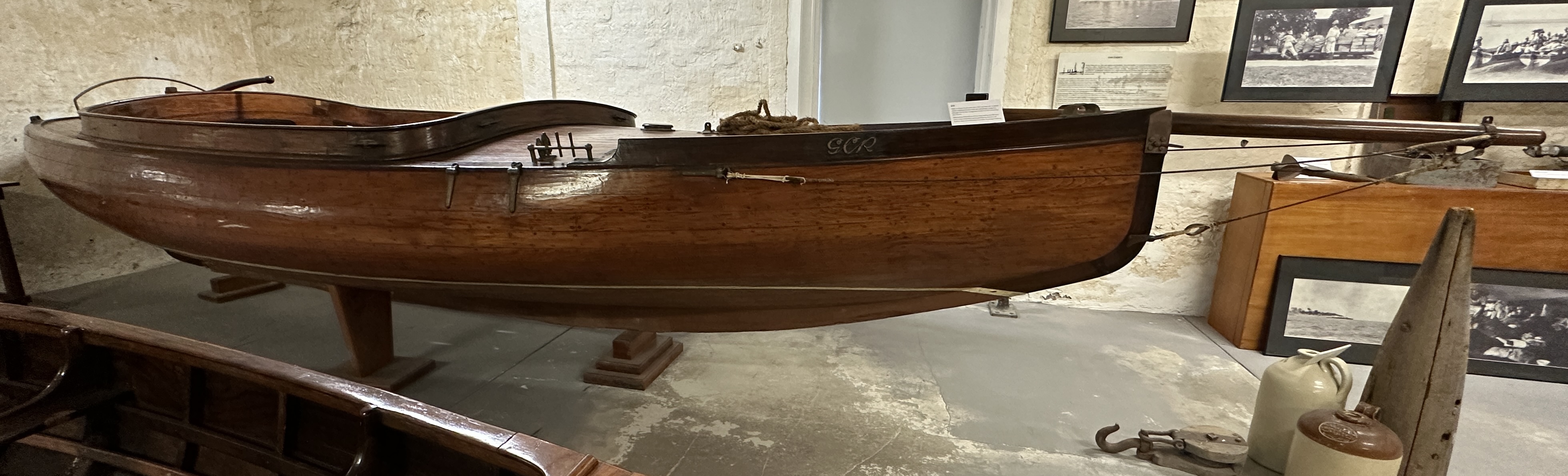
It was pouring with rain, but I had intended to visit the museum first. It was very interesting and included a lot of information that I hadn’t seen before about things that happened here. There were three boats in the museum. The first was built from turpentine wood, by the islanders, to plans supplied by John Clunies-Ross from Scottish designs in the 1800s. This boat is different to any Malay boat design of the time, but it’s also different to any Scottish boat too. 

The other two boats were also made by the cocos Malays. The larger one is from teak.

 
I tried to hire a golf buggy (almost all transport on Home Island is by golf buggy), but the person who hires them out wasn’t available. Then I went through the village to the place that sells food and had a delicious lunch. As it wasn’t really raining, I wandered to Oceania House which is rather run down.


I saw the school building where John Clunies-Ross and his wife taught the Cocos Malay children. They learnt how to write in Javan script.

And some interesting birds.


As it started to bucket down again , I went back to the ferry, but I’d got my wires crossed, and although there was a ferry from West Island that arrived at 11:30am, the next one back didn’t leave until 2:30pm. I met a family of two marine biologists and their two young children who were staying on the island because they found accommodation there until Thursday, when they’ll start camping on Direction Island since there’s nothing else available for a few weeks. There’s another family of marine biologists who have a baby who are also having trouble finding accommodation. I went to their place and after about an hour the rain had slowed again and I resumed my perambulations.

A person who had come over on the ferry with me offered me a lift in his golf buggy, and I discovered he was the shire infrastructure manager. He took me around parts that I hadn’t seen, and left me at the chicken houses that the cocos Malays keep some poultry in (there are chickens everywhere on both islands, and, I believe, all the others).


I walked back to the ferry through the town.

 
By this stage, it was bucketing down again. I saw a crab hiding under a golf buggy from the rain.

When we got back to West Island, all the school kids were waiting for the ferry to go home. It wasn’t raining, and I managed to catch a great sunset. You might be able to see the fins of the black tipped reef sharks.


Saturday, 3 February 2024

Coconut Forests

Overnight and this morning it rained. It is the rainy season, so what else would you expect?

Anyway, I decided to go out early and take pictures of land crabs because I figured they’d be out in the rain. And they were! Unfortunately, I took my water camera and all the crab pictures were completely out of focus. But it was excellent walking along the road seeing all the crabs.

I went back to my lodgings, changed and went to the lake. I took my phone because it was no longer raining. 

The Cocos (Keeling) Islands are unique in that they’re on two major bird migration flight paths - the East Asian-Australian flyway and the Indian flyway. At this time of year birds should still be nesting on the islands, but, of course North Keeling Island is where they tend to nest because it still has native vegetation and no humans and the feral animals they’ve brought. However, birds do also nest at the fresh water lake that’s located on West Island (where I’m staying). There’s a path through the coconut forest to the lake, and a bird hide at the lake.

There were lots of crabs on the way, but since I’d already photographed them, I didn’t take any pictures. The path narrowed, and then I came to the lake.


Unfortunately, there weren’t any birds. On my way out I saw a hermit crab - a fair way from shore, where they normally reside.


Then I visited another beach. At most beaches there is a tub of emergency supplies including a radio phone.


There were lots of hermit crabs here, hiding in the shade of the shelter.

I was really interested in the tracks they left underneath the picnic tables in the shelter.


The best laid plans

Today I intended to visit Direction Island, rated Australia’s best beach in 2018. I ordered a special picnic lunch, which was delivered at 9am, so I had plenty of time to drive to the ferry after sorting out my stuff so I could carry it all. You are supposed to drive at no more than 30 kph in the town, and 50 kph on the rest of the island, and the jetty is about 10 minutes drive away, with a 5 minute walk along the jetty. There was a convoy of five cars going to the jetty. After I parked my car a kind person offered to take the bags of those who were walking, as he was driving along the jetty to the ferry. Unfortunately, he kept my water in his ute and just dropped off my bag, so I had no water to take to Direction Island. Some people tried to get my water but had no luck. So I didn’t go. Hopefully I’ll go on Thursday when the ferry next goes there.

So I decided to see if there were any more tours available while I’m here. The answer was not a one! This is the low period for tourism here. I’d guess that there aren’t more than 20 tourists in the entire atoll.

Then I decided to snorkel at the Scout Park, which also has a beach with coral and is very close to an island you can snorkel around. It’s a beautiful place. Even the road to it is beautiful.


However, I decided the current was too fast, since I was by myself - the tide was coming in too rapidly. There were lots of fish and some coral right at the beach. I even saw sea cucumbers even though I didn’t go in very far at all.

I went further along the road to the yacht club, but that beach was all sand, so I didn’t go in. It was also completely deserted.

 
Both beaches are pretty iconic tropical south sea island beaches. I was glad I’d visited them, and intend to visit the scout park beach again.


Friday, 2 February 2024

Reaching Cocos (Keeling) Islands

Today I reached Perth Airport quite early. I was lucky I did, because it took me some time to find the right checkin counter. I started by going to domestic checkin, but the kiosk said I was flying internationally! 

So I wandered all the way through the international checkin counters and reached the end without finding it. The person at that counter said I had to go all the way back to the first counter after the domestic ones. So I trundled back again. And there it was! It wasn’t open yet, but I knew I was at the right place without reading the signs. The islands aren’t very fertile, being sand from coral breaking up, so the islanders don’t produce much food, although they do have a lot of seafood. So everything is very expensive. The Cocos Malays have a lot of family in Perth and other parts of Western Australia, and the high school only goes to year 10, so there’s a fair bit of travel between the islands and Perth. Every time anyone goes, they bring eskys of frozen fish from the islands and go back with cardboard boxes of stuff and eskys of frozen halal meat. The checkin queue has a couple of reels of plastic bags that are big enough to fit the polystyrene eskys, and everyone puts all the eskys they’re taking into a plastic bag so they don’t leak. The picture shows one person’s luggage but the queue flowed onto the concourse by the time they started checking people in even though we were in a prop plane and a lot of rows were empty.


We stopped at Learmonth to refuel before heading across the Indian Ocean for four hours.

You really realise how empty the ocean is when you think that the Cocos (Keeling) Islands are the only piece in all that space.

You don’t see much before you land, because it’s small.


Here’s a picture from my balcony. It’s a very nice place.


Towards Perth

The trip to Cocos (Keeling) Islands is taking me a day. It’s located almost exactly halfway between Perth and Sri Lanka. It’s not really near anything else, being 900km from Christmas Island.

There are two atolls. One has only one island which is gradually losing its lagoon, as there are now no external entries. This is North Keeling Island. It’s a fair way from the other atoll (about thirty five miles from memory), and has a lot of original fauna and flora as it was never inhabited.

The other atoll has 27 islands. The largest two are inhabited - Home Island where the Cocos Malays live, and West Island where the airport is and most of the administrative facilities are, including most tourism facilities.

In the 1820s, two completely different men decided to claim the islands and live here. The first to settle was Alexander Hare, who had been a colonial governor in Borneo who brought 40 mainly Malay women to be his harem although he stopped in South Africa along the way. About a year later, a staunch Presbyterian, John Clunes-Ross also decided to settle here with his family and some sailors and workers from the Malay area. You can walk between the islands at low tide as long as you don’t mind wading. So fairly shortly, the ladies of the harem and the men had become involved with one another, and Hare left. Many years later, Clunes-Ross persuaded Queen Victoria to give the islands him and his heirs in perpetuity, and five generations ruled the islands as a coconut plantation, with the indentured labourers they imported to provide the labour to produce copra. The Cocos Malays developed their own language and customs, mainly based upon Indonesian Muslim traditions, although some traditional Scottish dancing and music are part of the mix. The islands of the atoll were all planted with coconut palms.

The islands were quite strategically important, and an undersea cable went through the islands to connect Australia to the rest of the world, the first Australian navy engagement was here, and in the Second World War an airstrip was built on West Island (where administration now is) and the had thousands of allied troops stationed on it.

After the Second World War, the straights settlements became independent from Britain. Until then, both Cocos (Keeling) Islands and Christmas Island were administered by Britain from Singapore. So at that time Britain transferred both settlements to Australia. The United Nations had a list of 24 places without independence, and Cocos (Keeling) Islands were one of them. An investigative team decided that the islanders were little more than slaves, and Australia was under pressure to do something about it. They bought most of the land (except 5 acres surrounding Oceania House - the Clunes-Ross mansion) from the current John Clunes-Ross, and stopped the copra plantation production. In 1984 the islanders voted to become part of Australia by a resounding majority (88%). They are the most north westerly part of Australia.

Most of this I already knew, but sat next to a lawyer who had represented John Clunes-Ross during the land acquisition and the vote when I was flying from Canberra to Melbourne on the way to Cocos (Keeling) Islands today. He’d been there four times, and we had a really interesting discussion.